
How to Replace Machined Aluminum Tooling and ABS with Carbon Fiber Reinforcement
Introduction
Machined aluminum tooling such as jigs, jaws, and fixtures has long been the standard in manufacturing. However, with the rise of advanced 3D printing technologies—especially continuous carbon fiber reinforcement—industries can now produce stronger, lighter, and more cost-effective tooling in a fraction of the time.
Markforged 3D printers combine continuous carbon fiber reinforcement with industrial reliability to deliver parts that are up to 26× stronger than ABS, ready for same-day use straight off the printer.
What Is Machined Aluminum Tooling?
Machined aluminum tooling refers to precision-manufactured components such as:
- Jigs
- Jaws
- Fixtures
These parts are traditionally produced using CNC machining, which involves longer lead times, higher costs, and dependency on external vendors.
Machined Aluminum vs Carbon Fiber Reinforcement
Machined Aluminum – Pros & Cons
Pros
- High strength
- Good thermal stability
- Proven performance
Cons
- High manufacturing cost
- Long lead times
- Difficult to modify or replace
- Requires skilled machining and tooling
Carbon Fiber Reinforcement – Pros & Cons
Pros
- Extremely high strength-to-weight ratio
- Faster production (same-day parts)
- Lower cost compared to machining
- Easy design iteration and customization
Cons
- Limited to specific 3D printer platforms
- Requires design for additive manufacturing (DFAM)
Introduction to 3D Printing
3D printing, also known as additive manufacturing, has transformed industries such as automotive, aerospace, defense, manufacturing, dentistry, and more.
Unlike traditional manufacturing, 3D printing builds parts layer by layer, allowing complex geometries, reduced waste, and faster turnaround times.
Although introduced in the 1980s, 3D printing is now widely adopted due to its lower costs, speed, and flexibility.
3D Printing Technologies Used
The most widely used 3D printing techniques include:
- Fused Filament Fabrication (FFF)
- Continuous Fiber Reinforcement (CFR)
Continuous Fiber Reinforcement is the key technology that enables replacement of machined aluminum tooling.
3D Printing vs Traditional Manufacturing
Traditional Manufacturing
- Multiple steps: molding, machining, finishing, shipping
- Higher cost for low-volume parts
- Long lead times
- Requires bulk production
3D Printing
- Digitally driven process
- Faster time-to-market
- Cost per part remains constant
- Ideal for low-volume and customized parts
Key Advantages of 3D Printing
- Unlimited customization at no extra cost
- Rapid prototyping and design iteration
- Complex geometries in a single process
- Reduced inventory and warehousing
- Eco-friendly with minimal scrap waste
Introduction to Markforged 3D Printers
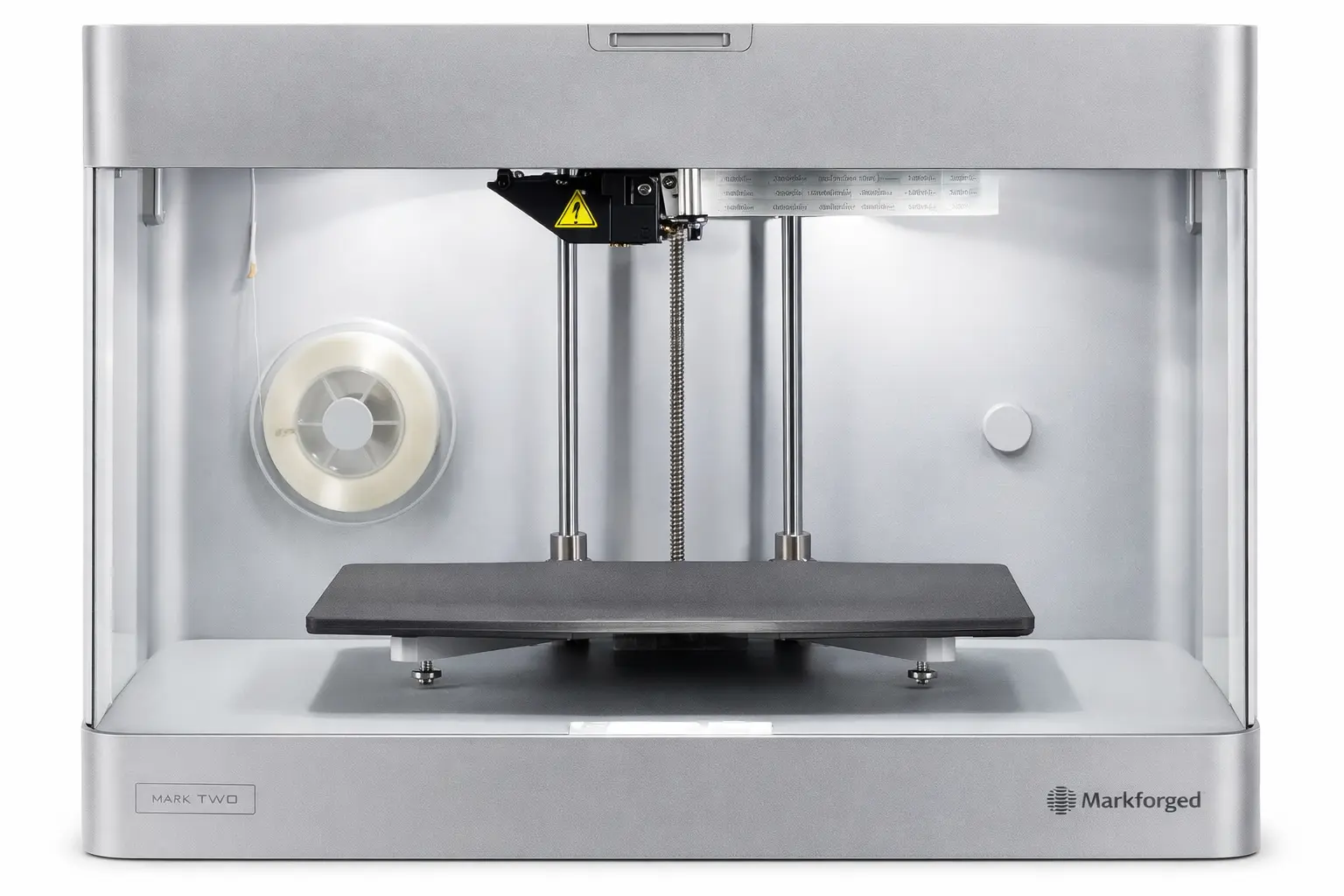
Markforged industrial 3D printers are designed to produce industrial-grade parts with unmatched strength and precision.
Markforged Printer Range
- Metal X System
- X7, X5, X3
- Mark Two
- Onyx Pro
- Onyx One
This article focuses on the Mark Two Carbon Fiber 3D Printer.
Why Choose Markforged 3D Printers?
- Industrial-grade strength and reliability
- High precision and repeatability
- Simple operation via a centralized software platform
- Easy maintenance with a streamlined workflow
How Continuous Fiber Reinforcement Works
1. Design & Slice
Design your part in any CAD software and follow Design for Additive Manufacturing (DFAM) principles.
2. Reinforce
Using Eiger software, select either composite base material or continuous fiber reinforcement based on application requirements.
3. Print
Markforged printers use dual nozzles—one for composite base material and one for continuous fiber—printing layer by layer with high accuracy.
4. Application
Printed parts are ready for use in:
- Jigs & fixtures
- Jaws
- Brackets & mounts
- Functional prototypes
Note: Continuous carbon fiber is supported only on Markforged X7 and Mark Two printers.
Features of Mark Two Carbon Fiber 3D Printer
The Mark Two is the only desktop printer capable of producing continuous carbon fiber reinforced parts that replace machined aluminum.
Key Features
- Replaces machined aluminum tooling
- High reliability for long print hours
- Exceptional surface finish and precision
- Continuous fiber reinforcement technology
- Composite base filaments and continuous fibers
Supported Materials
- Onyx
- Nylon
- Carbon Fiber
- Fiberglass
- Aramid Fiber (Kevlar)
- HSHT Fiberglass
Why Replace Machined Aluminum with Carbon Fiber?
- Prints metal-strength parts with lower weight
- 6× stronger and 18× stiffer than Onyx
- Flexural strength of 540 MPa
- Faster production and same-day usability
- Significant cost savings
What to Replace?
Carbon fiber reinforced 3D printing is ideal for:
- Jigs
- Jaws
- Fixtures
When to Replace?
- Obsolete tooling
- Broken or damaged components
- Preventive maintenance requirements
How MRO Uses This Technology
MRO operations leverage carbon fiber reinforcement to rapidly replace aluminum tooling at a fraction of the cost. For example, industries requiring lightweight yet strong parts—such as sports equipment, bicycles, and automotive components—benefit greatly from carbon fiber’s performance advantages.
Conclusion
Continuous fiber 3D printing has revolutionized manufacturing by offering the highest strength-to-weight ratio in additive manufacturing. Applications include jigs and fixtures, brackets, CMM fixturing, and custom end-use parts.
For these reasons, MRO teams increasingly replace machined aluminum tooling with carbon fiber reinforced 3D printed parts, achieving faster turnaround and significant cost savings.
FAQs
Is 3D printing cost-effective?
Yes. 3D printing reduces manufacturing time, material waste, and overall production costs.
What are the applications of 3D printing?
3D printing is widely used in manufacturing, aerospace, defense, automotive, dentistry, education, research, and industrial design.
What are the most widely used 3D printing techniques?
- Fused Filament Fabrication (FFF)
- Fused Deposition Modeling (FDM)
What is continuous carbon fiber reinforcement?
Continuous carbon fiber reinforcement is a unique Markforged process where carbon fiber is laid continuously within a printed part, achieving a flexural strength of 540 MPa and flexural stiffness of 60 GPa.